E-commerce · from $750

Storefront Packages

Turn a product line into a clear, buyer-ready catalog. Start with validation or payment links, launch a full cart, add stronger merchandising and measurement, or scope custom commerce operations.

From $750

Package tiers

These are the five retained storefront tiers. Cart, checkout, accounts, feeds, and automation appear only when the selected scope supports them.

Storefront Preview — $750

Outcome: a shareable product catalog that validates the collection and buying story before payment operations are added.

  • Catalog architecture and individual product pages
  • Mobile presentation and inquiry or commission CTA
  • No live payment processing, cart, accounts, or fulfillment automation

Payment-Link Store — $1,200

Outcome: a lean store where each product page routes buyers to a configured Stripe payment link.

  • Everything needed for the catalog presentation
  • Stripe payment links for the agreed products
  • No shared cart, customer accounts, inventory engine, or custom checkout logic

E-Commerce Launch — $2,997

Outcome: a production selling flow with cart and checkout paths for a product brand ready to transact online.

  • Full cart and checkout architecture
  • Initial setup for up to 20 products; larger migrations are quoted
  • Policy, analytics, feed, account, builder, and fulfillment features only when named in scope

Growth Store — $3,997

Outcome: a larger production store with stronger collection structure, merchandising, measurement, and launch testing.

  • Everything in E-Commerce Launch
  • Initial setup for up to 30 products
  • Enhanced collection architecture, analytics, merchandising, and checkout QA

Advanced E-Commerce — from $7,500

Outcome: a scoped commerce system for subscriptions, custom fulfillment, marketplace, data, or back-office integrations.

  • $2,500 discovery and architecture deposit only at checkout
  • Deposit applies to the approved project total
  • Final scope, milestones, cancellation, and refund terms are agreed before payment

Good fit, tier choice, and boundaries

Choose based on the transaction you need now, not on a feature list you may never operate.

Good fit

  • Makers and product brands with usable product photos, names, pricing, and fulfillment rules
  • Teams that need one durable page per product instead of a single crowded gallery
  • Early catalogs that can start with inquiry or payment links, then upgrade when order volume proves the need

Why choose the next tier

  • Choose Payment-Link over Preview when buyers must pay now but a shared cart is unnecessary
  • Choose E-Commerce Launch over Payment-Link when buyers combine products, need cart review, or require a managed checkout flow
  • Choose Growth Store over Launch when 21–30 products, richer merchandising, and stronger measurement are part of the fixed launch scope
  • Choose Advanced over Growth Store when subscriptions, custom fulfillment, marketplace sync, data migration, or back-office integrations are essential

Price drivers

  • Number and consistency of products, variants, photos, descriptions, and migration records
  • Cart, tax, shipping, discount, account, inventory, feed, and fulfillment requirements
  • Custom commission builders, calculators, subscriptions, or back-office integrations
  • Content cleanup, policy drafting, analytics events, and launch QA depth

Storefront process

  1. Catalog intakeProducts, variants, pricing, images, policies, payment method, and fulfillment ownership are confirmed.
  2. Conversion architectureWe map category, product, trust, cart or payment-link, and post-purchase paths before implementation.
  3. Technical buildProduct templates, checkout integration, responsive behavior, analytics events, and scoped integrations are implemented.
  4. Measurement and QAWe test product links, totals, forms, checkout handoffs, mobile layouts, metadata, and critical purchase events.
  5. Launch and next upgradePreview can move to payment links; payment links can move to a cart; full commerce can add custom operations when volume justifies them.

Storefront proof — catalog, checkout, and ops handoff

Storefront tiers are judged by product UI, buyer confidence, and whether the commerce pattern matches how you actually sell — not by theme marketplace screenshots.

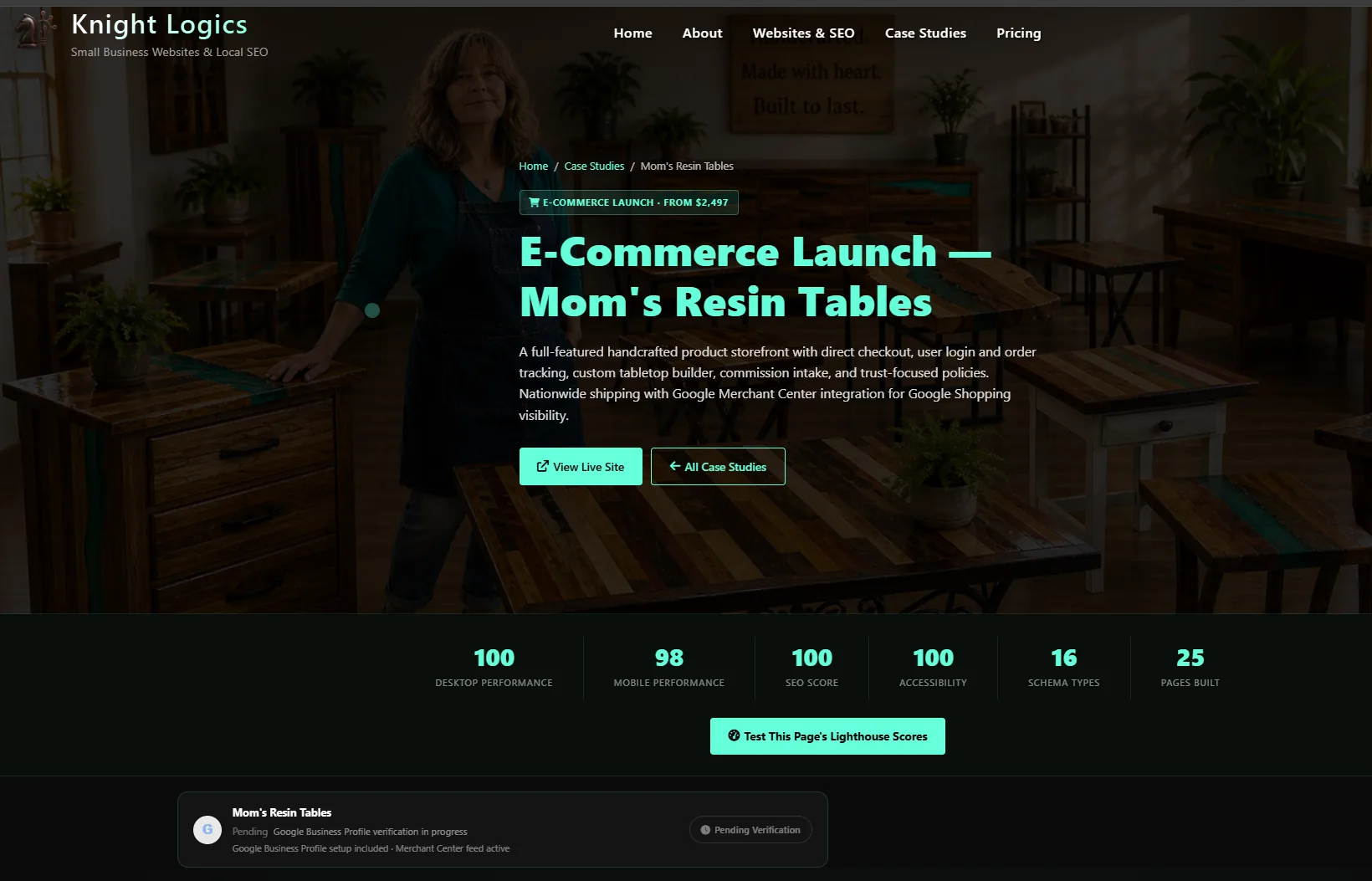
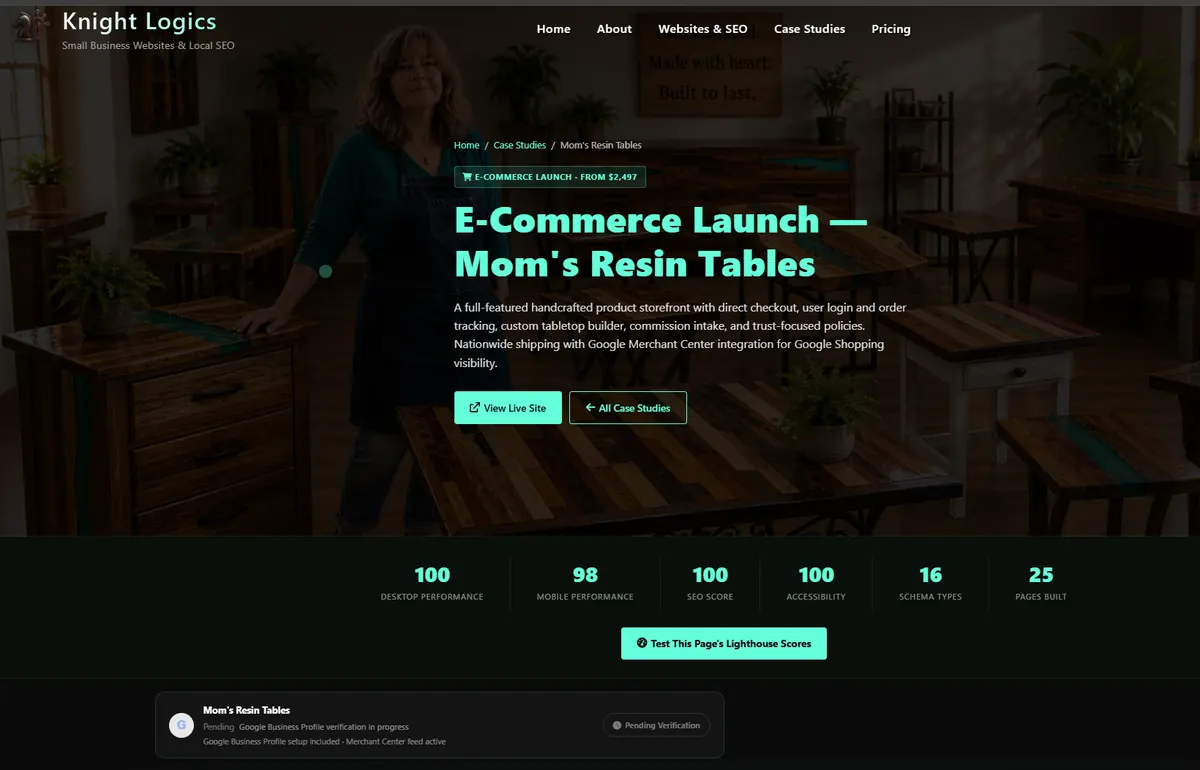
Mom's Resin Tables custom storefront with product pages and Stripe checkout

Custom commerce Mom's Resin Tables

Product storytelling, commission paths, and Stripe checkout

Hand-coded catalog for a maker brand that ships nationwide — individual product pages, custom build flows, and checkout without a locked page-builder tenancy.

  • Preview or Payment-Link tiers validate catalog before full cart scope
  • E-Commerce Launch adds shared cart and managed checkout when volume justifies it
  • Delivered feature set reflects historical custom scope — not every tier includes every Mom's feature
ManCaves.Store operational storefront with automated catalog population

Operational validation ManCaves.Store

Automated catalog population and fulfillment handoff

Man Caves Store is systems proof — JSON-driven catalog, search, and fulfillment routing — shown as operational validation rather than a design portfolio piece.

  • Structured product data instead of manual SKU babysitting
  • Payment-link or cart patterns scoped to the tier you operate
  • Visual redesign is a separate scope from operational proof
Client example

Mom's Resin Tables

Hand-coded product catalog, custom build/quote flows, Stripe checkout, and product pages built for a consumer brand that ships nationwide.

Mom's Resin Tables live e-commerce storefront on owned domain
Operational validation

Man Caves Store

Man Caves Store (mancavesstore.vercel.app / mancaves.store) is an operational validation environment for automated catalog population and fulfillment handoff.

It is shown as systems proof rather than a design portfolio piece: the useful evidence is the end-to-end product flow, automated population, and fulfillment routing. Visual redesign would be a separate scope.

ManCaves.Store operational storefront with automated catalog population

Proof and scope context

Mom's Resin Tables demonstrates a custom commerce build with product storytelling, checkout, and commission paths. Its delivered feature set reflects that client's historical custom scope; it is not a promise that every feature shown is included at today's $2,997 starting tier.

Next upgrade

Add a cart only after payment links become limiting. Add accounts, inventory, feeds, builders, shipping rules, or fulfillment automation only when operations require them. Ongoing visibility is separate from the storefront build; CRM and custom automation belong in a scoped Growth or Automation engagement.

Which storefront segment are you

Product businesses do not all sell the same way. Tier choice tracks how your buyer actually completes a purchase, not just your product count.

Makers and one-off commission brands

Resin, woodwork, custom furniture, art, and build-to-order goods where every unit has variables (size, finish, color) that a rigid cart handles poorly. Preview or Payment-Link Store fits early; a custom quote/commission flow like Mom's Resin Tables fits once volume justifies it.

Packaged product brands

Consistent SKUs, fixed pricing, and repeat buyers — candles, apparel, consumables, small-batch goods. E-Commerce Launch or Growth Store gives you a real cart, tax/shipping rules, and enough product room (20–30 items) to launch without over-scoping day one.

Multi-brand or franchise-style catalogs

Operators running several storefronts, wholesale plus retail, or a catalog that needs inventory sync, subscriptions, or marketplace feeds. Advanced E-Commerce is the scoped lane — deposit-first, architecture before code, because these builds are closer to software than templated pages.

Service brands adding a small shop

Contractors, trades, and local service businesses that want a small merch or parts storefront bolted onto an existing service site. Payment-Link Store usually wins here — no need for a shared cart when the core business is quotes and jobs, not volume retail. Pair it with the relevant home service growth system when the site itself also needs a rebuild.


Advanced E-Commerce proof assets

Advanced-tier proof — subscriptions, marketplace sync, or back-office integrations — publishes only once a matching scoped build is complete and cleared for public use.

Storefront FAQs

Do I need a cart on day one?

No. Preview validates the catalog first, Payment-Link Store collects money without a shared cart, and Launch adds full checkout once buyers are combining products.

What counts toward the 20 or 30 product limit?

Each distinct sellable listing at initial setup. Variants (size/color) on one listing do not multiply the count; a true migration of hundreds of SKUs is scoped separately.

Can Advanced start with a deposit?

Yes — $2,500 reserves discovery and architecture. The deposit applies to the approved total once scope, milestones, and terms are agreed.

Is ongoing catalog upkeep included?

No. Storefront tiers are project builds. Ongoing content, inventory, and promotional updates are Monthly Plans or a scoped automation engagement.